Vietnamese Four Sacred Creatures Tattoo: The Meaning of Tứ Linh
Vietnamese Four Sacred Creatures Tattoo designs explore the symbolism of Tứ Linh — Dragon (Long), Qilin (Lân), Phoenix (Phượng), and Tortoise (Quy) through contemporary tattoo art inspired by Vietnamese culture.
In Vietnamese Tattoo Part 2, Tattoo Station Hoi An transforms these legendary creatures into original tattoo compositions inspired by Vietnamese mythology, traditional architecture, temple decoration, carvings, and historical visual references.
Following Part 1: Pine & Bamboo Transforming into Dragons, this chapter continues our exploration of Vietnamese cultural heritage through contemporary tattoo design. Rather than simply copying historical motifs, each composition is reinterpreted to work naturally with the body while preserving a clear connection to its cultural inspiration.
Rather than simply copying historical motifs, each design begins with cultural research before being reinterpreted according to the artist’s own visual language and the anatomy of the person who will wear it.
The result is not intended to reproduce an ancient artifact.
It is a contemporary tattoo inspired by the cultural story behind it.
What Are the Four Sacred Creatures in Vietnamese Culture?
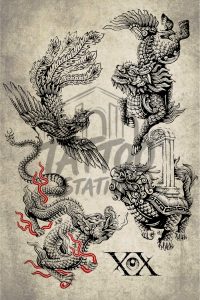
Known in Vietnamese as Tứ Linh, the Four Sacred Creatures traditionally consist of:
- Long (龍) — Dragon
- Lân (麟) — Qilin
- Quy (龜) — Tortoise
- Phượng (鳳) — Phoenix
These mythical and sacred creatures have appeared throughout Vietnamese traditional art, architecture, religious spaces, decorative objects, and historical visual culture.
Each carries its own symbolic associations.
Dragon (Long)
The Vietnamese dragon is associated with ideas such as power, prosperity, authority, transformation, and auspicious energy.
Its appearance changed considerably throughout different periods of Vietnamese history, creating a rich visual tradition for contemporary artists to research.
Qilin (Lân)
The Lân, often related to the broader East Asian Qilin tradition, is an auspicious mythical creature associated with peace, protection, prosperity, and benevolence.
Its distinctive appearance makes it one of the most recognizable creatures within traditional Vietnamese decorative imagery.
Phoenix (Phượng)
The Phượng is associated with beauty, harmony, virtue, prosperity, and renewal.
Its long feathers and flowing silhouette also make it particularly suitable for tattoo compositions requiring movement.
Tortoise (Quy)
The sacred tortoise represents ideas connected with longevity, stability, endurance, and knowledge.
Unlike the other three creatures, the tortoise is also a real animal that became deeply embedded in Vietnamese historical legends and cultural symbolism.
Together, Long, Lân, Quy, and Phượng create a symbolic system that has inspired generations of Vietnamese artists and craftspeople.
Today, those same references can become the foundation for contemporary tattoo design.
From Tứ Linh to Contemporary Vietnamese Tattoo Art
Creating a tattoo inspired by Tứ Linh does not mean simply reproducing an image found on an old temple wall.
For us, historical imagery is a reference point.
The first step is understanding the visual characteristics and cultural context of the subject.
The second is deciding how those elements can be translated into tattoo language.
Traditional architectural decoration may contain extremely complex patterns designed for wood, stone, ceramic, or metal.
Skin behaves differently.
A tattoo therefore needs its own hierarchy of:
- Line weight
- Contrast
- Negative space
- Movement
- Scale
- Detail
- Body flow
By adapting these characteristics rather than copying historical artwork literally, an artist can create a piece that remains connected with its cultural inspiration while functioning successfully as contemporary body art.
Vietnamese Dragon Tattoo – Long
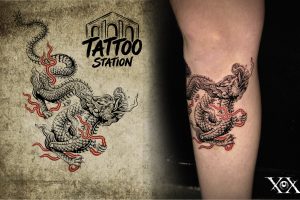
The Vietnamese Dragon Tattoo is perhaps the most immediately recognizable of the four designs.
Known as Long, the dragon has occupied an important position within Vietnamese mythology, imperial symbolism, architecture, and decorative art.
Its visual appearance has also evolved throughout different periods of Vietnamese history.
Rather than treating all East Asian dragons as visually interchangeable, our approach begins by studying Vietnamese references.
The flowing body provides a natural foundation for tattoo composition.
Curves can follow the anatomy of an arm, leg, shoulder, back, or torso, while clouds, flames, whiskers, scales, and surrounding decorative elements can create movement throughout the piece.
In this design, the dragon represents more than physical power.
It can also symbolize:
- Transformation
- Wisdom
- Ambition
- Prosperity
- Growth
- Movement
For someone choosing a dragon tattoo as part of their personal story, transformation may become the most important meaning.
The dragon can represent the person they are becoming rather than simply the creature itself.
Vietnamese Qilin Tattoo – Lân
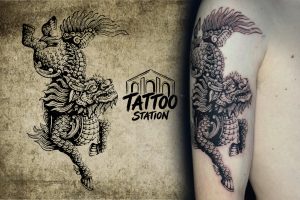
A Vietnamese Qilin Tattoo inspired by the Lân of traditional Vietnamese culture, representing auspicious energy, protection, peace, and prosperity.
The Vietnamese Lân offers a completely different visual personality.
Although powerful in appearance, the creature is traditionally associated with auspicious qualities rather than uncontrolled aggression.
This contrast creates an interesting tattoo concept:
Strength guided by wisdom.
The Lân can be represented through expressive facial features, flowing mane details, ornamental textures, dynamic movement, and decorative elements inspired by Vietnamese visual culture.
As a tattoo, it may represent:
- Protection
- Prosperity
- Benevolence
- Peace
- Good fortune
- Strength with restraint
This makes the Vietnamese Qilin Tattoo particularly suitable for someone who wants a mythical creature design that communicates protection and strength without relying exclusively on aggressive imagery.
Vietnamese Phoenix Tattoo – Phượng
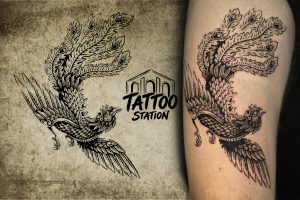
The Vietnamese Phoenix Tattoo creates an opportunity for a much more fluid composition.
Known as Phượng, the phoenix appears throughout Vietnamese traditional decorative art and architecture.
Its long feathers, elegant body, and flowing silhouette naturally create movement.
This makes it particularly effective for areas of the body where the tattoo can follow anatomy rather than remain inside a rigid frame.
Symbolically, the phoenix can represent:
- Harmony
- Beauty
- Virtue
- Prosperity
- Renewal
- Personal transformation
For some people, the idea of renewal becomes particularly meaningful.
A phoenix-inspired design can mark the end of one chapter and the beginning of another.
However, the artwork does not need to tell the same story for everyone.
The cultural symbol provides the foundation.
The person wearing it provides the personal meaning.
Vietnamese Sacred Tortoise Tattoo – Quy
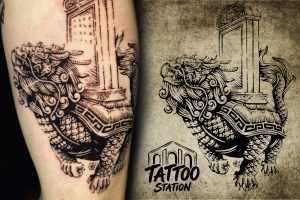
A Vietnamese Sacred Tortoise Tattoo inspired by Quy symbolism, combining ideas of longevity, endurance, stability, and knowledge with contemporary tattoo composition.
The Sacred Tortoise, or Quy, introduces a different type of strength.
Where the dragon creates movement and the phoenix creates elegance, the tortoise communicates stability.
Its symbolism can include:
- Longevity
- Endurance
- Stability
- Knowledge
- Patience
- Wisdom
The tortoise also has particularly strong connections with Vietnamese historical and legendary imagery.
For tattoo design, its shell provides an interesting surface for incorporating patterns, architectural details, geometric structures, or other cultural references.
This allows the artist to create a visually complex piece while maintaining a strong central silhouette.
A Sacred Tortoise Tattoo can be especially meaningful for someone who values patience, knowledge, stability, or the ability to endure through time.
Long – Lân – Quy – Phượng: Four Different Meanings
One of the strengths of the Vietnamese Four Sacred Creatures Tattoo concept is that the wearer does not necessarily need all four creatures.
Each can stand alone.
The choice depends on the story you want the artwork to communicate.
Choose Long (Dragon) for transformation, ambition, power, and movement.
Choose Lân (Qilin) for protection, prosperity, peace, and benevolence.
Choose Phượng (Phoenix) for harmony, beauty, renewal, and transformation.
Choose Quy (Tortoise) for longevity, endurance, stability, and knowledge.
They can also be combined.
For a larger tattoo project, two or more sacred creatures can create a more complex composition, particularly across the back, chest, thighs, or a large sleeve.
However, adding more cultural symbols does not automatically make a tattoo more meaningful.
Every element should have a reason to be there.
Engraving Style and Vietnamese Sacred Creatures
Tứ Linh imagery contains an enormous amount of visual information.
Scales.
Feathers.
Hair.
Clouds.
Flames.
Shell patterns.
Architectural ornaments.
Decorative lines.
When translated directly into a tattoo without a clear visual hierarchy, these details can become crowded.
An engraving-inspired approach provides one way to organize that complexity.
Fine directional lines can create texture.
Bold areas establish contrast.
Negative space separates important forms.
Different line weights help establish depth.
This creates a visual language particularly suitable for mythical creatures and ornamental compositions.
Instead of every detail competing for attention, the viewer can first recognize the overall creature and then discover smaller details when looking more closely.
Designing for the Human Body
A strong illustration is not automatically a strong tattoo.
Tattoo composition needs to consider anatomy.
A dragon can wrap around an arm.
A phoenix can follow the shoulder and upper arm through the movement of its feathers.
A Lân can create a powerful focal point on the thigh or upper arm.
A tortoise can work within broader symmetrical or architectural compositions.
Before finalizing a design, our artists consider:
- Body placement
- Available space
- Natural muscle direction
- Movement
- Scale
- Detail
- Long-term readability
This is particularly important for detailed cultural tattoos.
Trying to fit too much historical ornamentation into a small area can make the final piece difficult to read.
Sometimes removing a detail makes the cultural reference stronger rather than weaker.
Every Tattoo Begins with a Story
Originality is central to the way these designs are developed at Tattoo Station Hoi An.
A custom project begins with a conversation.
Why did you choose this creature?
What does it mean to you?
Is your connection cultural, personal, spiritual, or related to your journey through Vietnam?
Where will the tattoo be placed?
How large can the composition be?
Those answers influence the final artwork.
Instead of starting with a finished tattoo found online, the artist starts with the story and cultural references.
Every line is then developed as part of a new composition.
The goal is not simply to make something different.
The goal is to make the design belong to the person wearing it.
Why Original Vietnamese Tattoo Designs Matter
Culturally inspired tattoos require more than visual attractiveness.
Symbols have histories.
Their appearance can change across periods, regions, materials, and artistic traditions.
For that reason, research is an important part of the design process.
At the same time, tattooing is a contemporary medium.
A successful design needs to balance cultural inspiration with the practical requirements of skin, anatomy, placement, and aging.
Our approach is therefore not to reproduce historical objects exactly.
Instead, we use cultural references as a foundation for creating original contemporary artwork.
This distinction matters.
Inspiration preserves the story.
Design gives that story a new form.
A Tứ Linh Tattoo as a Memory of Vietnam
For international travelers, Vietnamese cultural imagery can also carry memories of a journey.
Perhaps you discovered a dragon carved into an old temple.
Perhaps you noticed a phoenix decorating traditional architecture.
Perhaps you encountered stone tortoises at a historical site.
Or perhaps learning about Vietnamese mythology introduced you to Tứ Linh for the first time.
A tattoo can transform those experiences into a permanent personal symbol.
Rather than simply saying:
“I visited Vietnam.”
The artwork can represent something you discovered, learned, or felt while you were here.
This is one reason custom cultural tattoos can become particularly meaningful travel memories.
Vietnamese Four Sacred Creatures Tattoo FAQ
What are the Four Sacred Creatures of Vietnam?
The Four Sacred Creatures, known as Tứ Linh, are traditionally Long (Dragon), Lân (Qilin), Quy (Tortoise), and Phượng (Phoenix).
They appear throughout Vietnamese traditional culture, mythology, architecture, and decorative art.
What does a Vietnamese Four Sacred Creatures Tattoo mean?
A Vietnamese Four Sacred Creatures Tattoo can represent a combination of qualities associated with Long, Lân, Quy, and Phượng, including transformation, prosperity, protection, harmony, longevity, endurance, and wisdom.
The exact meaning depends on which creatures are included and the personal story behind the tattoo.
Is Tứ Linh unique to Vietnam?
The Four Sacred Creatures belong to a broader East Asian cultural tradition and are not exclusive to Vietnam.
However, Vietnam developed its own visual interpretations of these creatures through different historical periods, artistic traditions, architecture, religious spaces, and decorative arts.
A culturally informed Vietnamese tattoo should therefore study Vietnamese references rather than treating all East Asian versions as identical.
What does a Vietnamese Dragon Tattoo symbolize?
A Vietnamese Dragon Tattoo can represent power, prosperity, transformation, wisdom, ambition, and growth.
Its exact symbolism can change depending on the historical inspiration and personal meaning of the design.
What does a Vietnamese Qilin Tattoo symbolize?
A Vietnamese Qilin or Lân Tattoo can represent protection, benevolence, peace, prosperity, good fortune, and strength guided by wisdom.
What does a Vietnamese Phoenix Tattoo symbolize?
A Vietnamese Phoenix Tattoo can represent harmony, beauty, virtue, prosperity, renewal, and personal transformation.
What does a Sacred Tortoise Tattoo symbolize?
A Sacred Tortoise or Quy Tattoo can represent longevity, stability, patience, endurance, knowledge, and wisdom.
Can I combine all Four Sacred Creatures in one tattoo?
Yes, but the available body area and desired level of detail are important.
A composition containing all four creatures usually requires significantly more space than a tattoo focusing on only one.
For smaller placements, selecting the creature that best represents your personal story may create a stronger design.
Final Thoughts
A Vietnamese Four Sacred Creatures Tattoo offers an opportunity to explore one of the most fascinating symbolic traditions associated with Vietnamese visual culture.
Long represents power and transformation.
Lân represents protection and auspicious energy.
Phượng represents harmony and renewal.
Quy represents longevity and stability.
Together, they form Tứ Linh.
But the purpose of contemporary cultural tattooing is not simply to place four historical symbols onto the skin.
The challenge is transforming cultural research, symbolism, anatomy, and personal meaning into one coherent piece of artwork.
That philosophy continues throughout the Vietnamese Tattoo Series at Tattoo Station Hoi An:
Vietnam provides the cultural inspiration.
Your story gives the tattoo its personal meaning.
Pillar Internal Link
Recommended Cluster Links
- Vietnamese Tattoo Part 1
- Vietnamese Tattoo Part 3
- Vietnamese Tattoo Part 4
- Vietnamese Tattoo Part 5
- Vietnamese Tattoo Part 6
- Vietnamese Tattoo Part 7