Dong Son Tattoo: Ancient Vietnamese Symbols & Meanings
Dong Son Tattoo designs transform some of Vietnam’s most remarkable ancient visual heritage into contemporary body art. Inspired by the imagery found on Đông Sơn bronze drums, these tattoos can incorporate stylized human figures, long-beaked birds, ceremonial boats, geometric patterns, and the distinctive radiating motif found at the center of many drums.
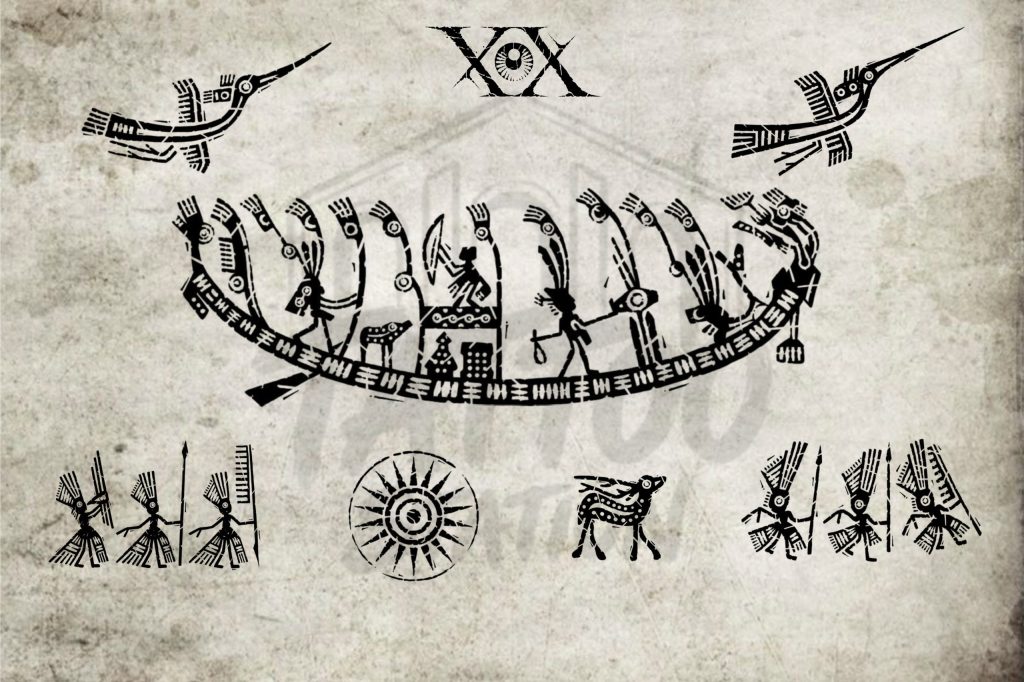
In Vietnamese Tattoo Part 3, Tattoo Station Hoi An explores four visual subjects inspired by Đông Sơn art: warriors, birds, ceremonial boats, and the central star motif of the bronze drum.
Rather than tracing archaeological objects directly onto the skin, artist Trxx studies their visual language — rhythm, repetition, geometry, movement, and storytelling — before rebuilding those references into original tattoo compositions.
Every design is then adapted according to the wearer’s anatomy, placement, scale, and personal story.
The goal is not to reproduce the past.
The goal is to understand it, respect it, and give it a new life through contemporary tattoo art.
What Is a Dong Son Tattoo?
A Dong Son Tattoo is a contemporary tattoo inspired by visual elements associated with the Đông Sơn culture and its archaeological heritage.
The Đông Sơn cultural tradition developed in northern Vietnam during the first millennium BCE and is particularly famous for its sophisticated bronze craftsmanship.
Among its most recognizable surviving objects are elaborately decorated bronze drums.
Their surfaces contain complex visual compositions featuring human figures, birds, boats, geometric bands, architectural forms, and other imagery arranged around a central radiating motif.
For tattoo artists, these objects provide an extraordinary visual archive.
However, there is an important distinction:
An ancient Đông Sơn motif and a modern tattoo inspired by that motif are not the same thing.
The archaeological object belongs to its original historical context.
The tattoo is a contemporary interpretation.
Understanding that difference allows artists to work with Vietnamese cultural heritage respectfully without pretending that every modern tattoo meaning was necessarily the meaning intended by people thousands of years ago.
The Đông Sơn Bronze Drum: Inspiration Behind the Collection
The Đông Sơn bronze drum is one of the most recognizable archaeological objects associated with ancient Vietnam.
These drums demonstrate remarkable technical skill in bronze casting as well as sophisticated visual organization.
Their decorated surfaces often contain several concentric bands.
At the center is frequently a large radiating star-like motif.
Around it may appear geometric patterns, birds, human figures, houses, boats, and scenes involving groups of people.
The arrangement creates movement.
Rather than functioning like a single isolated illustration, the entire surface becomes a visual composition.
Figures repeat.
Birds appear in sequence.
Boats move around the drum.
Geometric borders establish rhythm.
For contemporary tattoo design, these characteristics are particularly interesting because tattoos also need to work through movement, repetition, proportion, and body flow.
At Tattoo Station Hoi An, these historical references become starting points rather than templates.
Why Đông Sơn Art Works So Well as Tattoo Inspiration
Thousands of years separate an ancient bronze drum from contemporary tattooing, yet the visual language of Đông Sơn art can feel surprisingly modern.
Many motifs use:
- Strong silhouettes
- Repeated geometric patterns
- Rhythmic compositions
- Clear directional movement
- Simplified human and animal forms
- Effective negative space
- Decorative borders
These characteristics translate naturally into blackwork, engraving-inspired, geometric, and illustrative tattoo styles.
The imagery can also be adapted to different scales.
A single bird can become a small minimalist piece.
A central bronze drum motif can work as a standalone circular tattoo.
A ceremonial boat can form a long horizontal or curved composition.
Multiple elements can also be combined into a larger Vietnamese heritage piece.
The challenge is knowing what to preserve and what to simplify.
1. Dong Son Warrior Tattoo – Strength & Determination
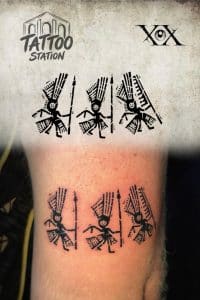
Human figures are among the most fascinating elements found in Đông Sơn visual culture.
Some scenes show groups of people participating in activities, carrying objects, performing ceremonies, or appearing within larger narrative compositions.
Their silhouettes are highly stylized.
Rather than attempting realistic anatomy, ancient artisans reduced the human body into strong geometric forms that remain immediately recognizable.
That visual simplicity makes these figures particularly suitable for tattooing.
Modern Meaning of a Dong Son Warrior Tattoo
It is important to distinguish archaeological evidence from contemporary interpretation.
We should not automatically assume that an ancient figure represented exactly the same ideas a tattoo wearer might associate with it today.
As a modern tattoo, however, a warrior-inspired Đông Sơn figure can personally represent:
- Strength
- Courage
- Discipline
- Protection
- Determination
- Connection with Vietnamese heritage
For someone with Vietnamese ancestry, the design might represent connection with cultural roots.
For a traveler, it may represent something discovered while learning about Vietnam’s ancient history.
For someone else, the figure may simply embody perseverance.
The historical image provides the inspiration.
The wearer provides the personal meaning.
2. Dong Son Bird Tattoo – Movement & Freedom
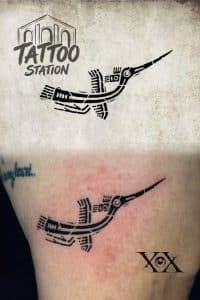
Long-beaked birds are among the most visually recognizable animal motifs associated with Đông Sơn bronze drums.
They often appear in repeated sequences, creating a powerful sense of movement around the circular surface.
Their elongated bodies, wings, necks, and beaks produce a silhouette that is both simple and elegant.
For tattoo design, this creates several possibilities.
A single bird can become a minimalist piece.
Several birds can form a repeating band.
A bird can also be incorporated into a larger composition with geometric patterns, boats, or the central drum motif.
What Can a Dong Son Bird Tattoo Mean Today?
Interpretations of ancient Đông Sơn bird imagery vary, and the exact meaning intended by its original creators should not be reduced to one simple modern definition.
For contemporary tattoo wearers, however, the bird can be personally interpreted through ideas such as:
- Movement
- Freedom
- Journey
- Direction
- Nature
- Cultural connection
- New beginnings
These are modern personal interpretations, rather than claims that every ancient Đông Sơn bird historically carried those exact meanings.
This distinction allows the design to remain respectful while still giving the tattoo personal significance.
3. Dong Son Ceremonial Boat Tattoo – Journey & Community
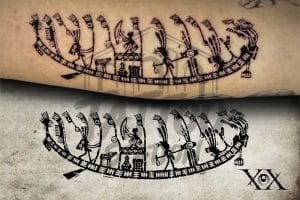
Boat scenes are among the most visually complex compositions associated with Đông Sơn bronze imagery.
Unlike a single isolated symbol, a boat can contain multiple figures and visual elements within one continuous scene.
This creates something particularly valuable for tattoo design:
a narrative.
The long structure of a boat naturally establishes direction.
Figures create rhythm.
Decorative elements create texture.
The entire composition appears to move from one point toward another.
Modern Tattoo Interpretation
For a contemporary wearer, a ceremonial boat-inspired design might personally represent:
- A journey
- Family
- Community
- Shared experience
- Migration
- Travel
- Cultural heritage
- Moving forward
Again, these should be understood as contemporary interpretations rather than definitive translations of the original archaeological imagery.
For travelers, the idea of a journey can be particularly meaningful.
A person may arrive in Vietnam at one stage of life and leave with a different perspective.
The boat can become a metaphor for that movement.
Not simply transportation from one place to another.
But movement from one chapter of life into the next.
4. Dong Son Drum Tattoo – The Central Star Motif
At the center of many famous Đông Sơn bronze drums is a striking radiating star-like motif.
It is one of the first visual elements people notice when viewing a drum from above.
Strong triangular rays extend outward from the center, while surrounding decorative bands create increasingly complex circular patterns.
This geometry makes the motif particularly effective as a tattoo.
It can work as:
- A standalone circular design
- A central element within a larger composition
- Part of an ornamental tattoo
- A geometric background
- A Vietnamese heritage symbol
- A connecting element between multiple cultural motifs
What Does the Đông Sơn Star Mean?
The central motif is frequently described in popular interpretation as solar or sun-related imagery.
However, when discussing ancient symbolism, it is better not to present one modern interpretation as absolute archaeological fact unless a specific historical source supports it.
For contemporary tattoo design, the radiating form can personally suggest:
- Energy
- Direction
- Balance
- Life
- Continuity
- A central point
- Connection with Vietnamese heritage
Its symmetry also makes it particularly suitable for areas where a balanced composition is desirable.
A Dong Son Drum Tattoo can therefore work both as a cultural reference and as a visually powerful geometric piece.
Combining Dong Son Tattoo Elements
One of the most interesting possibilities is combining several Đông Sơn-inspired elements into one composition.
For example:
Star + Birds
The central motif can provide a focal point while birds create movement around it.
Boat + Geometric Borders
A narrative scene can be framed with patterns inspired by decorative bands found on bronze drums.
Warrior + Drum Geometry
A human figure can become the primary subject while geometric elements establish a stronger connection with the visual language of Đông Sơn art.
Bird + Vietnamese Architecture
For a more contemporary interpretation, an ancient motif can be combined carefully with another Vietnamese cultural reference.
The important principle is restraint.
Adding more symbols does not automatically create a better Vietnamese tattoo.
Every element should have a visual and conceptual purpose.
From Ancient Bronze to Modern Skin
A bronze drum and human skin are completely different surfaces.
What works beautifully as a dense archaeological engraving may not work when copied directly into a tattoo.
This is why reinterpretation matters.
Ancient imagery may need to be:
- Simplified
- Enlarged
- Rebalanced
- Repositioned
- Separated with negative space
- Adapted to anatomy
- Reconstructed with different line weights
The objective is to preserve the recognizable character of the inspiration without forcing every historical detail into the tattoo.
This becomes especially important with small designs.
If too many tiny lines are placed into a limited area, the composition may lose clarity.
A successful tattoo needs room to breathe.
Dong Son Tattoo in Blackwork and Engraving Style
The graphic quality of Đông Sơn imagery makes it particularly compatible with black ink.
At Tattoo Station Hoi An, artist Trxx can reinterpret these historical references through techniques such as:
- Blackwork
- Engraving-inspired linework
- Geometric composition
- Controlled negative space
- Fine line details
- Strong silhouettes
Blackwork can emphasize the bold geometry of ancient motifs.
Engraving-style lines can introduce texture and depth.
Negative space prevents complex imagery from becoming visually crowded.
The result is not intended to imitate the exact surface of bronze.
Instead, the tattoo creates a new visual language inspired by the original artifact.
Best Placements for a Dong Son Tattoo
Placement depends heavily on which motif you choose.
Small Dong Son Tattoos
A single bird, geometric element, or simplified central motif can work well on areas such as:
- Forearm
- Upper arm
- Calf
- Ankle
- Shoulder
Medium Designs
Warriors, larger birds, and more detailed geometric compositions can benefit from additional space on the:
- Upper arm
- Thigh
- Calf
- Shoulder blade
Large Dong Son Tattoos
Ceremonial boats and compositions combining several ancient motifs require more room.
Possible placements include:
- Thigh
- Back
- Chest
- Large upper-arm composition
- Sleeve
The best placement is not simply the largest available area.
The direction of the historical motif should work with the direction of the body.
This is particularly important for boats, birds, and repeating geometric patterns.
Every Dong Son Tattoo Is Redesigned
At Tattoo Station Hoi An, the artwork in this collection should be understood as inspiration rather than reusable tattoo flash.
The same historical motif can inspire many completely different compositions.
Before designing a piece, artist Trxx considers:
- The cultural reference
- The client’s preferred motif
- Personal meaning
- Placement
- Anatomy
- Scale
- Direction
- Level of detail
The composition is then rebuilt for that individual project.
This means two people may both choose an Đông Sơn bird but receive completely different tattoos.
One might choose a single minimalist bird.
Another may combine several birds with geometric bands.
Someone else may incorporate the motif into a larger Vietnamese heritage composition.
The inspiration can be shared.
The final artwork should remain personal.
The Creative Vision of Artist Trxx
Every design in this chapter reflects the artistic approach of Trxx at Tattoo Station Hoi An.
With a background in fine arts, Trxx approaches culturally inspired tattoo projects through both visual research and contemporary composition.
Rather than simply tracing an archaeological image, he studies:
- Shape
- Rhythm
- Repetition
- Proportion
- Negative space
- Storytelling
- Historical visual references
He then considers how those characteristics can be translated onto the human body.
A composition originally designed for the circular surface of a bronze drum may need to become vertical for a forearm.
A long boat may need to curve naturally around a calf.
Repeated birds may need different spacing when wrapping around an arm.
This transformation from artifact to anatomy is where contemporary tattoo design begins.
For Trxx, the goal is not to recreate a museum object on skin.
It is to create new artwork that acknowledges where its inspiration came from.
Why Choose a Vietnamese Heritage Tattoo?
A Vietnamese heritage tattoo can create a connection between contemporary body art and the country’s visual history.
For Vietnamese clients, that connection may relate to ancestry, cultural identity, family, or curiosity about the past.
For international travelers, it may begin with discovering Vietnamese history during a journey through the country.
The most meaningful approach is not simply choosing an ancient symbol because it looks exotic.
Learn where the image came from.
Understand what historians can establish about it.
Recognize where interpretation begins.
Then decide what the symbol means to you.
That process creates a more thoughtful relationship between history and personal tattooing.
Dong Son Tattoo as a Memory of Vietnam
Travel tattoos do not always need to depict famous landmarks.
A memory of Vietnam can also come from something discovered along the journey.
A museum visit.
An archaeological object.
A traditional pattern.
A historical story.
A conversation with an artist.
For someone fascinated by Vietnamese history, a Dong Son Tattoo can become a subtle alternative to more familiar travel imagery.
Rather than tattooing the name “Vietnam,” the design can reference a visual tradition connected with the country’s ancient past.
Years later, the tattoo can still recall the moment when that history was first discovered.
Respecting Archaeology in Contemporary Tattoo Design
Cultural tattooing comes with responsibility.
Ancient imagery often survives without a complete written explanation of what every symbol meant to the people who created it.
Modern viewers naturally want to interpret those symbols.
But interpretation should not become invented history.
For that reason, our approach separates three things:
What can be observed:
The figures, birds, boats, geometry, and other visual elements present on archaeological objects.
What researchers interpret:
Scholarly theories and historical explanations based on archaeological evidence.
What the tattoo means personally:
The meaning chosen by the contemporary wearer.
These three layers can coexist.
A tattoo can be historically inspired without pretending that its personal meaning is an archaeological fact.
That distinction makes the artwork more respectful, not less meaningful.
Dong Son Tattoo FAQ
What is a Dong Son Tattoo?
A Dong Son Tattoo is a contemporary tattoo inspired by visual elements associated with the ancient Đông Sơn cultural tradition, particularly imagery found on decorated bronze drums.
Popular design references include birds, human figures, boats, geometric patterns, and the distinctive central radiating motif.
What was the Đông Sơn culture?
The Đông Sơn cultural tradition developed in northern Vietnam during the first millennium BCE and is particularly renowned for sophisticated bronze objects, including elaborately decorated drums.
These artifacts provide important archaeological evidence about the visual culture and material craftsmanship of ancient communities in the region.
What is a Dong Son Drum Tattoo?
A Dong Son Drum Tattoo uses imagery inspired by Đông Sơn bronze drums.
A design might focus on the central star-like motif, decorative geometric bands, birds, boats, human figures, or a combination of several elements.
What does the Đông Sơn star symbolize?
The central radiating motif is often popularly interpreted as a solar or sun symbol.
Because interpretations of ancient imagery require archaeological context, it is better not to claim that one modern explanation represents its only definitive historical meaning.
As a contemporary tattoo, the motif can be given a personal meaning by the wearer.
What do Đông Sơn birds symbolize?
Long-beaked birds are prominent visual elements on a number of Đông Sơn bronze drums.
Their exact ancient symbolism should be treated carefully rather than reduced to a single universal meaning.
Modern tattoo wearers may personally associate them with movement, freedom, travel, direction, nature, or cultural heritage.
Can I customize a Dong Son Tattoo?
Yes.
Historical imagery can be adapted according to size, placement, anatomy, and the desired composition.
At Tattoo Station Hoi An, the goal is to use archaeological references as inspiration while creating an original tattoo for the individual wearer.
What style works best for Đông Sơn-inspired tattoos?
These motifs work particularly well with:
- Blackwork
- Engraving
- Fine line
- Geometric tattooing
- Illustrative blackwork
- Contemporary Vietnamese-inspired designs
The best style depends on the motif, size, body placement, and amount of historical detail you want to preserve.
Is a Dong Son Tattoo suitable for foreigners?
Yes.
Cultural appreciation does not require Vietnamese ancestry, but understanding the origin of the imagery is important.
For travelers, learning about the historical reference before choosing the design can make the tattoo more meaningful and respectful.
Final Thoughts
A Dong Son Tattoo creates a bridge between ancient Vietnamese visual culture and contemporary body art.
Warriors provide powerful human silhouettes.
Birds create movement.
Ceremonial boats tell visual stories.
The central bronze drum motif introduces unmistakable geometry.
But the value of these designs does not come from simply copying an ancient artifact.
It comes from understanding the original visual reference and then creating something new.
At Tattoo Station Hoi An, artist Trxx approaches Đông Sơn-inspired tattooing through research, drawing, anatomical composition, and individual customization.
The ancient artwork provides the beginning.
The artist creates the interpretation.
The person wearing the tattoo completes the story.
Pillar Internal Link
Recommended Cluster Links
- Vietnamese Tattoo Part 1
- Vietnamese Tattoo Part 2
- Vietnamese Tattoo Part 4
- Vietnamese Tattoo Part 5
- Vietnamese Tattoo Part 6
- Vietnamese Tattoo Part 7